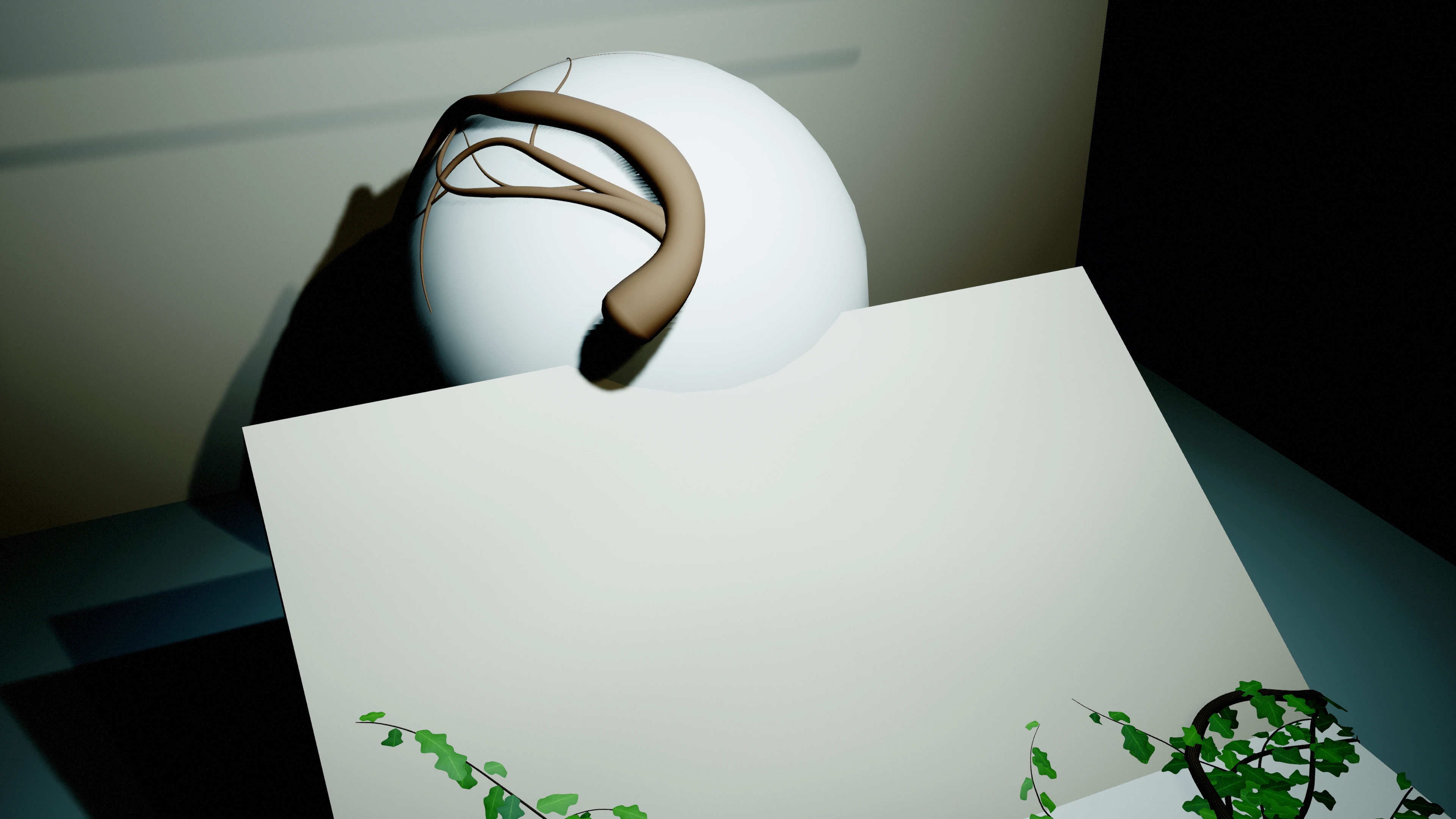
Generate a path, then reveal it
Growth playback rebuilds the visible stem and foliage along the actor's cached Generated Strands. It retains the complete paths, so changing progress does not recalculate the route or perform a fresh surface search each animation step. Use Regenerate when you change path settings or supporting geometry; use playback when you want to expose or hide an existing route.
- Generate the actor once and wait for Is Generating to become false. Confirm that the complete route follows the intended collision.
- Call Set Growth Progress(0) to start hidden, or use another value between 0 and 1 to choose a starting point.
- Set Growth Speed to a positive normalized rate. The default 0.2 requests a full 0-to-1 traversal in five seconds; geometry application is asynchronous and can lag the requested progress.
- Call Play Growth with Reverse disabled to reveal the path, or enabled to retract it.
- Call Pause Growth to pause playback. Call Play Growth again with the direction you want to continue. Read Is Growth Playing to check playback state.
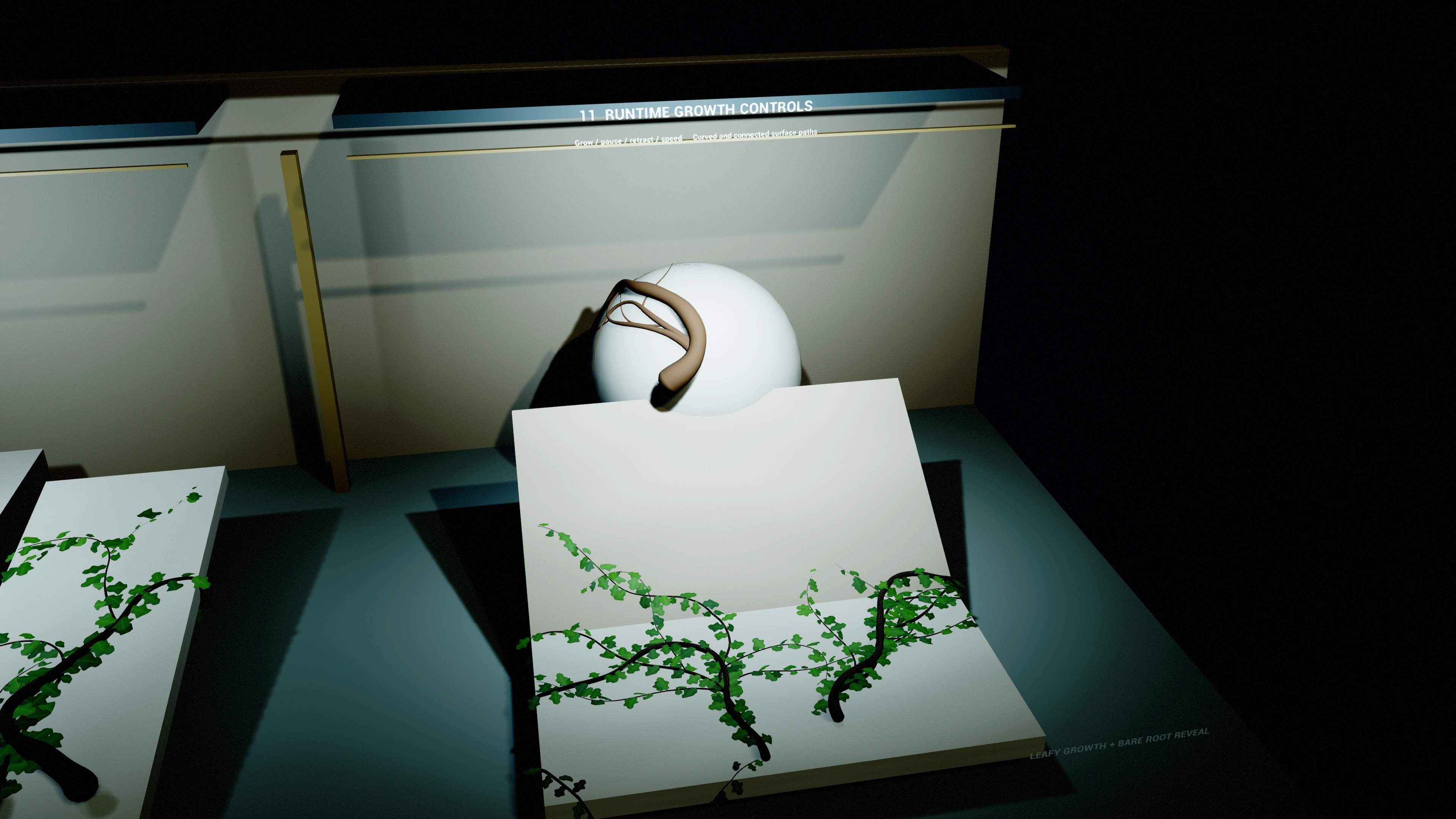
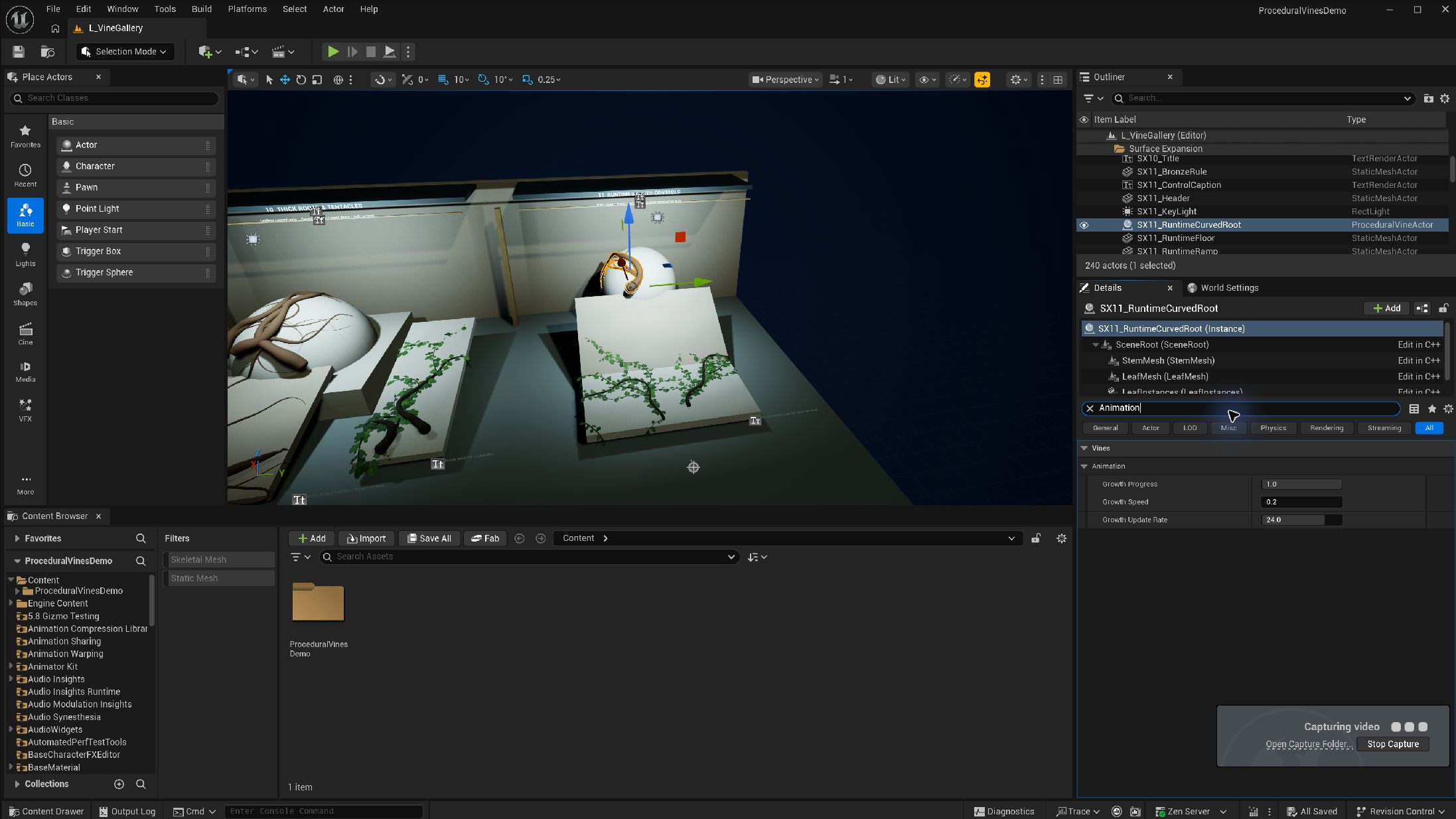
Playback properties
Swipe the table to read every column.
| Parameter | Default / type | Effect and use |
|---|---|---|
| Growth Progress | 1 / normalized float, 0–1 | Requested reveal amount: 0 hides the generated route and 1 displays it fully. Use Set Growth Progress when controlling it from Blueprint. |
| Growth Speed | 0.2 / normalized progress per second, clamped 0.001–10 | Playback rate along the complete generated route. This is not centimetres per second and does not set the vine's generation length. |
| Growth Update Rate | 24 / updates per second, clamped 1–30 | Maximum requested geometry-update frequency during playback. Reducing it lowers rebuild frequency but makes visible progress more stepped. |
| Grow On Begin Play | false / boolean | Starts hidden and requests forward growth when gameplay begins. Uses the actor's Growth Speed. |
| Grow On Begin Play Delay | 0 seconds / float, minimum 0 | Delay from Begin Play before automatic forward playback starts. Requires Grow On Begin Play. |
Swipe the table to read every column.
| Blueprint call | Use |
|---|---|
| Set Growth Progress(float) | Seek directly, clamped to 0–1. Active playback keeps its direction; pause first to hold a chosen amount. |
| Play Growth(bool Reverse = false) | Resume from current progress toward full visibility, or toward zero when Reverse is true. Reaching either endpoint pauses. If no paths exist and no job is pending, this may regenerate once. |
| Pause Growth() | Hold requested progress and pause the timeline. The latest in-flight geometry update is allowed to finish. |
| Is Growth Playing() | Read whether the playback timeline is active. |
| Get Applied Growth Progress() | Read the progress actually uploaded to render geometry. Compare it with requested Growth Progress when diagnosing asynchronous update lag. |
React to completion
Swipe the table to read every column.
| Blueprint event | Meaning |
|---|---|
| On Growth Finished | Playback reached requested progress 1, or 0 in reverse. The event supplies the vine actor and Retracted boolean. Geometry can still be applying. |
| On Generation Finished | Queued path or geometry work has settled. The event supplies the vine actor; this also covers completed cached reveal updates. |
Bind the events before starting playback. Use On Growth Finished for timeline logic. For a settled visual result, wait for Is Generating to become false and compare Get Applied Growth Progress with the requested value. Seeking directly with Set Growth Progress is not playback and does not itself emit On Growth Finished.
Frame-accurate offline capture
For an offline Sequencer or Movie Render Queue capture, add the actor's interpolatable Growth Progress property track and key it from 0 to 1, or backward for retraction. Generate and inspect the complete route first, and pause automatic playback while the track controls progress.
Set the console variable ProceduralVines.CinematicMode 1 for the offline render. It bypasses the normal slice budget and growth update-rate delay and waits for geometry work so requested changes can finish within the capture frame. This can block for expensive actors; use it only for offline capture, not gameplay. Restore ProceduralVines.CinematicMode 0 afterward. Check rendered frames around the start, branch reveals and end; do not judge timing from requested progress alone.
Branches, leaves and cost
Branches begin revealing after their parent attachment has been reached. Leaf placement consumes the deterministic full-path random sequence before applying the progress gate, so revealing more of the same generated route does not reshuffle its leaf choices.
Visible geometry work runs through asynchronous worker requests, with newer progress requests coalesced rather than queued without limit. Full stored strand counts and path lengths describe the cached route; they are not measurements of only the visible fraction. Playback does not remove the cost of geometry construction, mesh uploads, materials or shadows. Last Surface Trace Count reports zero for a completed cached reveal job; an initial generation still performs traces.
Is Growth Playing describes the timeline, while Is Generating describes queued or active geometry work. After pausing or reaching an endpoint, wait for Is Generating to become false and inspect Get Applied Growth Progress when you need a settled visual result. Clear pauses playback, cancels pending work and removes the stored paths; Set Growth Progress alone does not restore them.
Disable Generate Stem Collision when the supporting scene already provides the collision you need. Rebuilding collision during playback adds cost; station 11 disables decorative stem collision. Treat Growth Update Rate as an update-frequency control, not a frame-rate guarantee.
This is reveal and retraction of generated geometry. It does not provide a biological growth simulation, skeletal tentacle deformation, character IK, network replication or automatic tracking of moving surfaces.